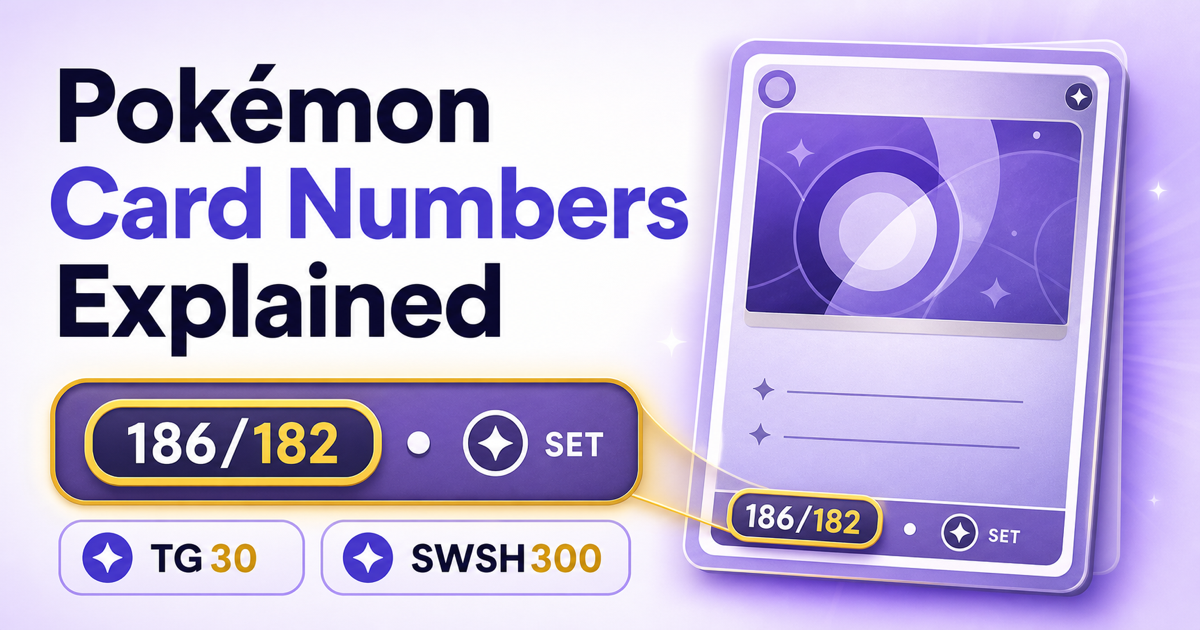
- 1First number
The card's position in that release or sequence. - 2Second number
The printed size of the main numbered set. - 3Set marker
The context that makes a repeated number useful. - 4Rarity and treatment
Separate clues to confirm after the number.
The quick answer
The number at the bottom of a Pokémon card is its collector number. In 186/182, 186 identifies the card within that release and 182 is the printed size of the main numbered set. Because 186 is higher than 182, the card sits beyond the main sequence. Always pair the number with the set code or symbol.
Pokémon card numbers are identification numbers, not price tags. A number such as 138/195 helps place a card inside an expansion, while 186/182 shows that the card is numbered beyond the main set sequence. Prefixes such as TG or SWSH identify a subset or promo series. The number becomes dependable only when you confirm the set marker, language, artwork, and variant too.
What do the two numbers on a Pokémon card mean?
On many Pokémon cards, the collector number appears as two numbers separated by a slash:
card number / printed main-set size
For example, 138/195 means the card carries collector number 138 in a release whose main numbered sequence is printed as 195 cards. The official Pokémon TCG rulebook labels the fields at the bottom of a modern card as the expansion code and collector card number.
- The first number identifies that card within the release or numbered sequence.
- The second number gives the printed size of the main set sequence.
The denominator is not always the total number of collectible cards associated with a release. An expansion can include cards numbered beyond that denominator, and special galleries or promo series can use their own numbering system.
What does 186/182 mean on a Pokémon card?
186/182 means collector number 186 in a release whose main numbered sequence ends at 182. Because 186 is greater than 182, the card is outside that main sequence.
Collectors often describe any card numbered above the denominator as a secret-numbered card or secret rare. Treat that as a useful search phrase, not a complete rarity label. Official rarity names vary by set and era. For example, the official Pokémon card database lists Crustle 186/182 from Destined Rivals as an Illustration Rare. Magby from Paradox Rift also uses 186/182, which proves that the fraction alone does not identify a unique card.
- 186 tells you the card's position in that release.
- 182 is the printed size of the main numbered sequence.
- 186 > 182 tells you the card is beyond that main sequence.
- The set code, name, artwork, and official rarity tell you which card it actually is.
An above-set number does not by itself prove that a card is authentic, valuable, or difficult to pull. Those are separate questions.
Common Pokémon card-number formats
| Printed format | What it usually indicates | Official example |
|---|---|---|
| 138/195 | A card within a main expansion sequence | Lugia V is referenced as 138/195 in an official Pokémon strategy deck list |
| 186/182 | A card numbered beyond the main sequence | Crustle 186/182, Illustration Rare, Destined Rivals |
| TG30 | A separately numbered Trainer Gallery card | Mew VMAX TG30, Lost Origin Trainer Gallery |
| SWSH300 | A Sword & Shield promotional-series number | Unown V SWSH300, Sword & Shield Promo |
| RC + number | A Radiant Collection subset identifier in releases that use it | Generations includes a 32-card Radiant Collection subset |
These are conventions, not a promise that every Pokémon card from every era follows one layout. When the printed format looks unfamiliar, use the exact characters shown and compare them with the official card database or checklist for that release.
Where is the collector number on a Pokémon card?
On many modern cards, look along the bottom edge near the expansion code and rarity mark. The exact left-to-right order and placement can change between eras and card layouts.
- Hold the card under even light so the small print is readable.
- Check the lower-left and lower-right areas for a number, slash, or letter prefix.
- Copy the complete string, including leading zeroes and letters.
- Record the nearby set code or expansion symbol.
- Confirm the language before comparing catalog results.
If you cannot find the number, do not substitute the Pokédex number. A line such as NO. 0206 describes the Pokémon species; it is not the card's collector number.
For a diagram of the other fields, see How to Identify Pokémon Cards: Set, Number, Rarity, and Variant.
Why leading zeroes and prefixes matter
Write the number exactly as printed when you search. 079/131 and 79/131 point to the same numerical position, but the printed form helps you compare the physical card with a checklist or catalog result. A prefix changes the numbering system entirely: TG30 is not ordinary card 30, and SWSH300 is not card 300 of a standard Sword & Shield expansion.
Useful search patterns include:
- Pokémon name + complete collector number
- Pokémon name + set code + first number
- Complete prefixed number, such as SWSH300
- Pokémon name + gallery prefix, such as Mew VMAX TG30
Avoid searching only the first number. Card 79, for example, can exist in many unrelated expansions.
Can two cards have the same collector number?
Yes. Collector numbers are reused across expansions, and the same fraction can appear in more than one set. Magby and Crustle have both appeared as 186/182 in different expansions. Reprints can also share a name, attacks, or artwork while carrying a different expansion code or promo number.
Use the number as part of a compound identity:
name + set code or symbol + complete collector number + language + variant
That combination is much safer than a card name or number alone. Before comparing value, also verify whether the card is standard, holo, reverse holo, stamped, or another parallel treatment.
How to identify a card from its number with Pulldex
Pulldex can narrow a scan to a catalog match, but you should still verify the result against the physical card.
- Scan the card in clear, even light. Keep the full card visible and reduce glare over the small print.
- Open the identification result. Compare the displayed name, set, and card number with the card in your hand.
- Check the complete printed number. Do not accept a same-name result from another expansion simply because the artwork looks similar.
- Confirm the variant. Tilt the physical card to distinguish non-holo, holo, reverse holo, and special patterns.
- Then review price information. Use the Pokémon card price directory only after the printing and condition are correct.
For an above-set example, compare the physical card and catalog details with the Paradox Rift price guide or Destined Rivals price guide. Do not use a price from one 186/182 card for the other.
Identify the exact printing
Let Pulldex narrow down the match.
Scan a card, compare the set and collector number, confirm the variant, and only then review its price.

Common collector-number mistakes
Mistaking the Pokédex number for the collector number
The Pokédex or species number may appear near descriptive text on some Pokémon cards. It identifies the Pokémon species, not the card printing. The collector number is associated with the expansion or promo sequence.
Assuming a number above the denominator guarantees value
Above-set numbering helps categorize a card, but value also depends on the exact card, condition, language, variant, and current market evidence. The collector number does not supply a price.
Dropping a letter prefix
Searching 30 instead of TG30, or 300 instead of SWSH300, removes the information that identifies the gallery or promo series.
Matching the number but ignoring the set
Numbers repeat. A correct identification requires the nearby expansion code or symbol as well as the number.
Treating a scanner result as proof of authenticity
A scanner can identify the closest catalog match. It cannot guarantee that the physical card is genuine from one image alone. If authenticity is uncertain, inspect print quality, dimensions, materials, and provenance separately or consult a qualified in-person evaluator.
Pokémon card-number questions
Is the first or second number the card number?
The first number is the card's collector number within that release or sequence. In 138/195, the card number is 138. The second number is the printed size of the main numbered set.
Does a higher first number mean the card is a secret rare?
It means the card is numbered beyond the main sequence. “Secret rare” is common collector shorthand, especially for some eras, but use the official rarity printed for that set. Modern official names can include Illustration Rare, Special Illustration Rare, Hyper Rare, and other tiers.
What does TG mean in a Pokémon card number?
TG identifies a Trainer Gallery numbering sequence. The official Pokémon card database lists Mew VMAX TG30 under the Lost Origin Trainer Gallery rather than as ordinary card 30 of Lost Origin.
What does SWSH mean before a card number?
On an identifier such as SWSH300, SWSH marks the Sword & Shield promotional series. It is a promo identifier, not a slash-form main-set number.
Can a Pokémon card number tell me the price?
No. The number helps identify the printing. Price requires a match for the exact set, language, variant, and condition, followed by current market evidence.
Should I keep leading zeroes when searching?
Yes. Preserve the printed form whenever possible. A catalog may normalize 079 to 79, but keeping the leading zero helps you compare your search result with the physical card.
Sources and methodology
This guide uses official Pokémon rules, card records, checklists, and product pages. Examples were selected to show distinct numbering systems rather than to imply rarity, availability, or value.
- Pokémon Trading Card Game Rules: parts of a card
- Pokémon Support: using the Trading Card Game database
- Official card record: Crustle 186/182
- Official card record: Magby 186/182
- Official card record: Mew VMAX TG30
- Official card record: Unown V SWSH300
- Official Pokémon Generations overview
- Official Pokémon strategy article referencing Lugia V 138/195